
P100 FILTERS: Answering the Most Common Questions
Understanding P100 FILTERS is essential for individuals operating in environments with dangerous airborne particles. These filters deliver the utmost level of personal respiratory protection, effectively blocking at least 99.97% of particles, such as dust, bacteria, and asbestos. P100 FILTERS serve as a dependable barrier against both oil and non-oil based contaminants. This blog employs a question-and-answer format to facilitate quick access to the information you need. Explore how P100 FILTERS can boost your safety and guarantee clean air in demanding conditions.
Understanding P100 Filters
What is a P100 filter?
P100 filters offer the highest level of personal respiratory protection. These filters block at least 99.97% of airborne particles. You can rely on them to protect against dust, bacteria, and asbestos. The filters are oil-resistant, which means they work well in environments with oil-based particles. The universal color for P100 filters is purple, making them easy to identify.
Respirators are given rating based on the type and efficiency of filtering substances. There are a number of ratings, each starting with a letter to designate it’s effectiveness of oil.
- N – NOT resistant against oil or oil-based particles
- R – SOMEWHAT resistant to oil-based particles
- P – STRONGLY resistant to oil-based particulates
That letter is than appended with a number (95, 99 or 100) to represent how effective the mask/cartridges filters particulates.
Some examples include:
- N95 – Filters at least 95% of particulates, NOT resistant to oil.
- R95 – Filters at least 95% of particulates, SOMEWHAT resistant to oil.
- P99 – Filters at least 99% of particulates, STRONGLY resistant to oil.
- P100 – Filters at least 99.97% of particulates, STRONGLY resistant to oil.
Key Features and Benefits:
- High Filtration Efficiency: P100 filters capture particles as small as 0.3 microns. This makes them nearly impenetrable.
- Versatile Protection: They protect against various hazards like lead, asbestos, welding fumes, and fiberglass dust.
- Oil Resistance: P100 filters resist both oil and non-oil based particulates.
- Durability: These filters last longer in challenging conditions, providing reliable protection.
What is a P100 Respirator?
A P100 respirator is a device that uses P100 filters to provide respiratory protection. You will find these respirators essential in environments with hazardous airborne contaminants. The respirator ensures you breathe clean air by filtering out harmful particles.
Components and Functionality:
- Filter Cartridges: P100 filters attach to the respirator to block contaminants.
- Facepiece: This part fits snugly over your nose and mouth. It ensures no unfiltered air enters.
- Straps: Adjustable straps help secure the respirator in place.
Applications and Usage:
- Construction and Manufacturing: Workers use P100 respirators to protect against dust and fumes.
- Painting and Welding: These respirators are effective in filtering paint fumes and welding smoke.
- Healthcare Settings: Professionals use them to guard against airborne pathogens.
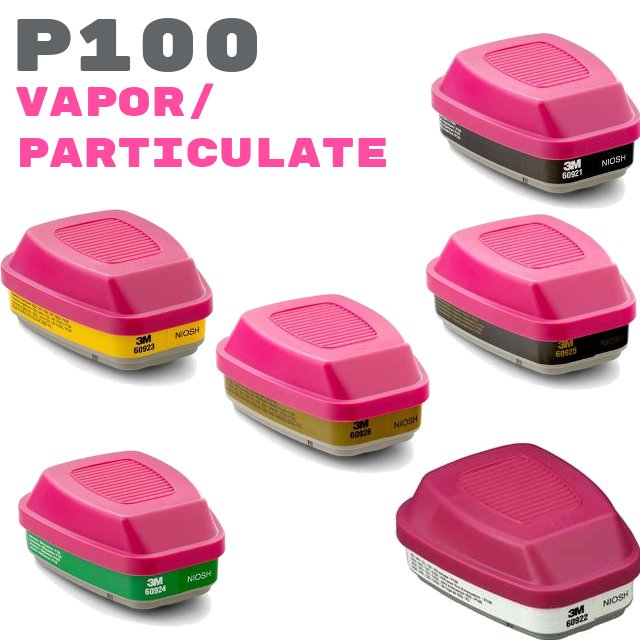
3M Offers a variety of filter cartridges for use with many 3M Reusable Respirators:
- SKU: 60921 – Organic Vapor Cartridges – Protects against: Organic Vapors
- SKU: 60922 – Acid Gas Cartridges – Protects against: Chlorine, Chlorine Dioxide, Hydrogen Chloride, Hydrogen Sulfide, Sulfur Dioxide
- SKU: 60923 – Organic Vapor / Acid Gas Cartridges – Chlorine, Chlorine Dioxide, Hydrogen Chloride, Hydrogen Fluoride, Hydrogen Sulfide, Organic Vapors, Sulfur Dioxide
- SKU: 60924 – Ammonia Methylamine Cartridges – Ammonia, Methylamine
- SKU: 60925 – Formaldehyde/Organic Vapor Cartridges – Formaldehyde, Organic Vapors
- SKU: 60926 – Multi Gas/Vapor Cartridges – Ammonia, Chlorine, Chlorine Dioxide, Formaldehyde, Hydrogen Chloride, Hydrogen Fluoride, Hydrogen Sulfide, Methylamine, Organic Vapors, Sulfur Dioxide
P100 filters and respirators are vital tools for anyone needing top-notch respiratory protection. You can trust them to keep you safe in various demanding environments.
Applications of P100 Filters

Are P100 Filters Good for Painting?
P100 FILTERS stand out as a top choice for painting projects. These filters excel at capturing paint fumes, ensuring you breathe clean air while working. The high filtration efficiency of P100 FILTERS blocks at least 99.97% of airborne particles, including those pesky paint fumes that can be harmful over time.
Effectiveness in Filtering Paint Fumes:
P100 FILTERS provide superior protection against paint fumes. The oil-resistant nature of these filters makes them ideal for environments with oil-based paints. You can trust P100 FILTERS to keep your lungs safe from harmful chemicals present in paint vapors.
Comparison with Other Filters:
When comparing P100 FILTERS to other options like N95, the difference is clear. P100 FILTERS offer higher filtration efficiency, capturing smaller particles and providing more comprehensive protection. While N95 filters might suffice for some tasks, P100 FILTERS are the go-to choice for environments requiring maximum protection. The added cost of P100 FILTERS pays off with enhanced safety and peace of mind.
Are P100 Filters Good for Welding?
Welding environments present unique challenges, and P100 FILTERS rise to meet them. These filters effectively shield you from welding fumes, which can contain hazardous substances like lead and cadmium. P100 FILTERS ensure you stay protected in demanding welding conditions.
Protection Against Welding Fumes:
P100 FILTERS excel at filtering out welding fumes, offering a barrier against harmful particles. The filters capture 99.97% of particulates, making them a reliable choice for welders. You can count on P100 FILTERS to safeguard your respiratory health during welding tasks.
Advantages Over Other Filters:
Compared to other filters, P100 FILTERS provide unmatched protection in welding environments. The ability to filter both oil and non-oil based particulates gives P100 FILTERS an edge over alternatives like N95. While N95 filters might struggle with oil-based fumes, P100 FILTERS handle them with ease. This makes P100 FILTERS the preferred option for welders seeking comprehensive respiratory protection.
Maintenance and Longevity
How Long Do P100 Filters Last?
P100 FILTERS offer outstanding protection, but understanding their lifespan is crucial. Various factors can affect how long these filters remain effective. The environment plays a significant role. Dusty or contaminated areas may shorten the filter’s life. Frequent use also impacts longevity. More usage means quicker replacement.
Factors Affecting Lifespan:
- Environmental Conditions: Dusty or polluted environments wear out filters faster.
- Frequency of Use: Regular use reduces the lifespan of P100 FILTERS.
- Exposure to Contaminants: High levels of harmful particles decrease filter effectiveness.
Recommended Replacement Schedule:
Replacing P100 FILTERS regularly ensures optimal protection. Manufacturers often suggest changing filters every 40 hours of use. Some users might need to replace them sooner. Pay attention to breathing resistance. Increased difficulty in breathing signals a need for a new filter.
Can P100 Filters Be Reused?
Reusing P100 FILTERS can be economical, but safety must come first. Not all situations allow for reuse. Filters exposed to hazardous substances should not be reused. Always inspect filters before considering reuse.
Guidelines for Reuse:
- Visual Inspection: Check for damage or clogging before reuse.
- Limited Exposure: Only reuse filters exposed to low levels of contaminants.
- Proper Storage: Store filters in a clean, dry place between uses.
Safety Considerations:
Safety remains the top priority when reusing P100 FILTERS. Never compromise on protection. If in doubt, opt for a new filter. Health risks outweigh cost savings.
Can P100 Filters Be Cleaned?
Cleaning P100 FILTERS might seem like a good idea, but it can reduce effectiveness. Most filters are not designed for cleaning. Attempting to clean them may damage the filtration material.
Cleaning Methods:
- Avoid Water: Water can ruin the filter’s structure.
- No Chemicals: Chemicals degrade the filter’s protective layer.
- Gentle Brushing: Lightly brush off surface dust if necessary.
Impact on Filter Effectiveness:
Cleaning P100 FILTERS often leads to reduced performance. The filtration efficiency drops after cleaning attempts. Always prioritize safety by replacing rather than cleaning.
Comparing P100 Filters with Other Filters

P100 vs N95 Filters
Differences in Protection Levels
P100 FILTERS and N95 filters both offer respiratory protection, but they differ in efficiency. P100 FILTERS block at least 99.97% of airborne particles, making them highly effective against small particles and hazardous substances. N95 filters, on the other hand, capture 95% of particles. The higher filtration efficiency of P100 FILTERS makes them a better choice for environments with dangerous contaminants like lead and asbestos. Oil resistance is another advantage of P100 FILTERS, allowing them to perform well in oily environments.
Situations for Optimal Use
Choosing between P100 FILTERS and N95 filters depends on the specific environment. P100 FILTERS work best in settings with high levels of hazardous particles. These include construction sites or industrial areas. N95 filters suit less demanding environments where oil-based particles are absent. For maximum protection, especially in high-risk areas, P100 FILTERS provide peace of mind.
P100 vs N100 Filters
Comparative Analysis
P100 FILTERS and N100 filters both offer top-tier protection, but subtle differences exist. Both filter types capture at least 99.97% of airborne particles. However, P100 FILTERS have the added benefit of oil resistance. This feature makes P100 FILTERS more versatile in environments where oil-based particulates are present. N100 filters lack this oil resistance, limiting their use in certain conditions.
Use Cases
The choice between P100 FILTERS and N100 filters often comes down to the presence of oil particles. P100 FILTERS excel in environments with oil aerosols, such as automotive workshops or certain manufacturing plants. N100 filters perform well in non-oily settings, providing excellent protection against dust and other particulates. For comprehensive coverage, P100 FILTERS stand out as the more adaptable option.
P100 vs P95 Filters
Key Distinctions
P100 FILTERS and P95 filters share some similarities, but key distinctions set them apart. P100 FILTERS offer a higher filtration efficiency, capturing 99.97% of airborne particles. P95 filters capture 95% of particles, making them slightly less effective. The oil resistance of both filters allows them to function in oily environments, but the superior efficiency of P100 FILTERS provides an edge.
Application Scenarios
Selecting between P100 FILTERS and P95 filters depends on the level of protection needed. P100 FILTERS are ideal for high-risk environments with hazardous particles. These include areas with asbestos or welding fumes. P95 filters work well in less demanding settings, offering adequate protection against general dust and mist. For those seeking the highest level of safety, P100 FILTERS remain the preferred choice.