Granular vs Powdered Activated Carbon in Respirator Masks: What Buyers Should Check Before Sourcing
For disposable respirator masks, granular activated carbon held inside a cloth layer is usually the easier option for a buyer to specify, sample and inspect, because the carbon form, its placement and the layer construction can all be defined in writing before bulk production.
Granular and powdered activated carbon are not two names for the same material. They differ in particle form, in how they are held inside a mask or filter, and in how clearly a buyer can check them. Never buy “activated carbon” as a label alone: buy a defined carbon form, in a defined layer, in a defined product, for a defined market — in writing.
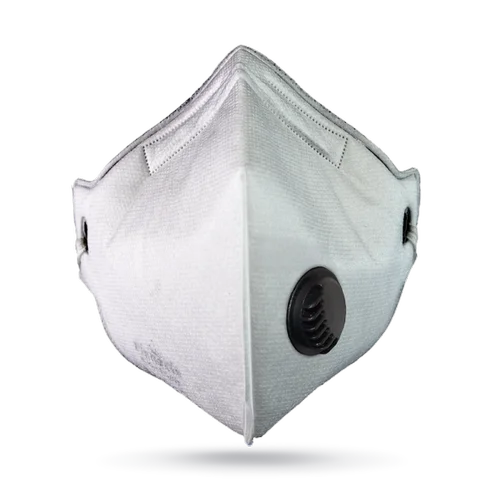
A flat-fold respirator mask with an activated carbon layer and exhalation valve.
What is the difference between granular and powdered activated carbon in a respirator mask?
Granular carbon consists of larger, hard particles; powdered carbon is a fine powder. Granular carbon is normally contained inside a fabric layer, while powdered carbon is normally applied as a coating or blend — so the two are specified, made and inspected differently.
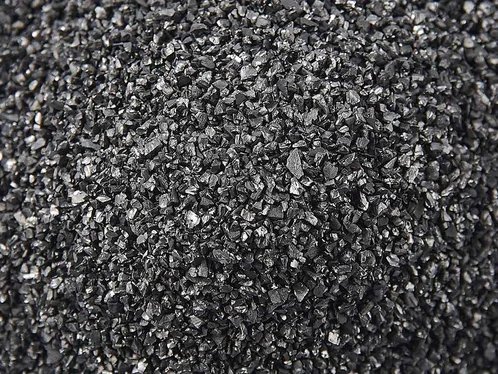
Granular activated carbon: larger, hard carbon particles held inside a cloth layer.
Activated carbon is carbon processed to create a very large internal surface area — the surface that adsorbs odours and certain vapours. The chemistry is broadly the same in both forms; what changes is the physical form, and how a manufacturer builds it into a product.
That matters commercially more than chemically. A contained granular layer can be cut open, photographed and described in a purchase specification. A powdered coating is harder to see and easier to describe loosely — which is why two masks that both say “activated carbon” can be built very differently.
| Check point | Granular activated carbon | Powdered activated carbon |
| Physical form | Larger, hard carbon granules | Fine carbon powder |
| How it is held | Contained inside a cloth or fabric layer | Coated onto, or blended into, a layer |
| What a buyer can specify | Carbon form, layer position, layer construction | Carbon form, coating method, layer construction |
| What a buyer can inspect | Layer presence, position and evenness, by cutting a sample open | Coating coverage and evenness on the surface |
| Main risk if unspecified | Layer construction changes without notice | Carbon content and coverage vary invisibly |
| Typical product forms | Folding masks, cup-shaped masks, pre-filter media | Coated filter media, some mask layers |
Neither form is a performance claim on its own. Suitability depends on the complete product, its classification and its test documentation, not on the carbon form alone.
Which carbon form should distributors choose for folding masks?
For folding (flat-fold) masks, ask for the carbon layer construction first, then check how the finished mask folds, packs and presents on the shelf — where a carbon layer most often creates distributor complaints.
A folding mask packs flat and ships efficiently; a carbon layer changes the feel and thickness of the mask body.
- Fold behaviour: Ask whether the carbon layer runs across the full mask body or only part of it. Check that folded samples open out cleanly and sit flat again after packing.
- Packing: Confirm the packing format in writing — for example, individually packed or bulk packed, pieces per inner box and per carton — before comparing prices.
- End-user expectation: State on your listing what the carbon layer is for, and what it is not for, using the supplier’s written intended-use statement.
Which carbon form should distributors choose for cup-shaped masks?
For cup-shaped masks, the deciding checks are whether the carbon layer follows the formed cup evenly, and whether the mask keeps its shape through packing, shipping and storage.
A cup-shaped mask is pre-formed, so its layers are shaped rather than flat: layer placement is a manufacturing question. Evaluate the whole cup, not one cut corner.
- Layer coverage: Cut one sample open and check the carbon layer across the breathing area, not only in the centre.
- Shape retention: Check samples from a packed carton, not only loose samples.
- Straps, valve and nose piece: Confirm in writing which strap type, valve and nose-piece options are offered for the model you are buying.
- Range planning: List the carbon version as its own line — with its own SKU, price point and description — not as a silent replacement for your standard cup mask.
How does the carbon form affect pre-filter media?
In pre-filter media, the carbon layer is one layer in a system. Confirm which respirator and which filter or cartridge the media is intended to be used with, and never assume compatibility.
Pre-filters sit in front of a main filter or cartridge on a reusable respirator. They are the replaceable, lower-cost layer changed more often, while the main filter or cartridge behind it is changed less often. A carbon version adds an odour-management layer to that format.
Three checks decide whether a carbon pre-filter belongs in your range:
- Stated compatibility: Ask the supplier to name, in writing, the respirator models and filter or cartridge types it is intended for. “Universal” is not a specification.
- Format: Confirm shape, holder or retainer arrangement and packaging quantity, so customers can reorder the correct consumable.
- Range fit: Check it against the reusable respirators, filters and Disposable Respirators you already sell, so the pre-filter matches a product your customers actually use.
Also confirm the standard for the complete respirator-and-filter combination: a pre-filter alone is an accessory, not a certified respirator.
What should buyers check on a specification sheet before sourcing?
A specification sheet is complete enough to buy from only when it states the carbon form, layer construction, product form, standard and class for your market, intended use and limits, and commercial terms. Anything missing should be confirmed in writing, not assumed — two quotes that look identical on price often differ in exactly these rows.
| Specification item | What to ask the supplier to state |
| Carbon form | Granular or powdered, stated explicitly, including the carbon source material |
| Layer construction | Where the carbon layer sits, and how it is held in place |
| Product form | Folding mask, cup-shaped mask or pre-filter media |
| Standard and class | The standard and class the model is supplied to for your market, with the supporting documents |
| Intended use and limits | A written statement, including what the product is not for |
| Models covered | The exact models and SKUs included in the quotation |
| Branding options | Which logo, colour, packaging and instruction options can be customised |
| Minimum order quantity | MOQ per model, and per branded variant if it differs |
| Lead time | Sample lead time and bulk production lead time, stated separately |
| Shelf life and storage | The stated shelf life and the storage conditions it requires |
| Documents available | Test reports, declarations and certificates available for your market |
Apply one rule to every supplier: ask for the document for the exact model, for the exact market. Certification availability varies by product and destination, and one model’s document does not cover another model.
What should buyers check when inspecting samples?
Work through one fixed inspection — including cutting one sample open — and record the result, so the bulk order can be checked against the sample you approved.
- Confirm the sample matches the quotation: model, product form and carbon form.
- Check packaging, labelling and branding as your customer will receive them.
- Handle the product: look for loose particles, damaged layers and uneven surfaces.
- Cut one sample open: confirm the carbon layer’s presence, position and evenness across the breathing area.
- Check straps, nose piece and valve (where fitted) for secure attachment.
- Folding masks: fold and unfold several times, and check that the mask still presents cleanly.
- Cup-shaped masks: check shape retention on a sample taken from a packed carton.
- Pre-filter media: check the format against its intended reusable respirator and holder.
- Compare a second sample from a different carton — never approve one hand-picked piece.
- Photograph everything, keep one sealed reference sample, and attach the photos to your order.
Keep the reference sample. In a dispute, it and the written specification are what settle the argument.
Which questions should buyers ask a supplier before placing a bulk order?
Ask these questions in writing. A manufacturer who controls its carbon layer can answer all of them; vague answers are themselves an answer.
- Is the carbon granular or powdered, and how is it held in the layer?
- Which models use granular carbon cloth, and in which forms — folding, cup-shaped or pre-filter media?
- Which written specification will be attached to my order, and will production follow it?
- Which standard and class is this exact model supplied to for my market, and which documents can you share?
- What is the carbon layer’s stated intended use, and what are its stated limits?
- Can I receive samples from regular production, and keep a sealed reference sample?
- What is the MOQ per model, and does it change for private-label packaging?
- What are the sample and bulk production lead times, stated separately?
- What is the stated shelf life, and what storage conditions does it require?
- Which branding elements can be customised, and what proof will I approve before production?
- How are batches identified, and how would a quality claim be traced?
- Who is my contact for specification changes, and how are changes notified before production?
Ask any supplier to walk you through the full sequence for your order — requirement and product selection, sampling, testing, packaging, production, inspection and shipment — and to explain how batches are traced.
When is powdered activated carbon still a reasonable choice?
Powdered carbon is not automatically a bad product. It becomes a sourcing problem only when its form, coating method and content are left unspecified and unchecked.
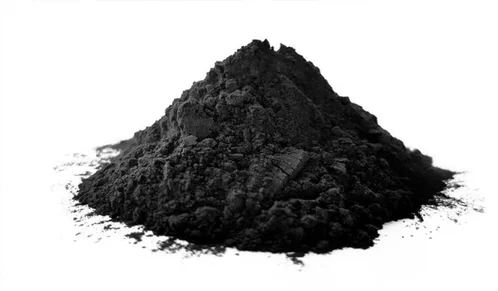
Powdered activated carbon: a fine powder, normally applied as a coating or blend.
Some designs use a powdered coating or blend as the manufacturer’s chosen construction, and buyers can source them successfully — on the same conditions as any respirator purchase: the construction described in writing, the documentation your market requires, samples passing your fixed inspection, and an accurate product listing.
What you should not accept, in either form, is a quotation offering “activated carbon” with no form, no layer description and no document list. That is an undefined product, and the risk — returns, complaints, delisted lines, or a tender rejected on documents — lands on the distributor, not on the factory.
Compare total cost, not unit price: unit price, plus freight on the actual packed volume, plus inspection time, plus expected returns and complaint handling, plus re-listing costs if the construction changes without notice. A defined granular carbon cloth construction is easier to hold stable across repeat orders, which is usually the lower-risk basis for a private-label line.
What are the limits of an activated carbon layer in a disposable mask?
A carbon layer in a disposable respirator does not turn it into a gas and vapour cartridge respirator. Publish the intended use and the limits, and match the product to the workplace assessment and the applicable standard.
Disposable respirators — folding or cup-shaped, with or without a carbon layer — are particulate respirators classified under standards such as EN 149. Gas and vapour protection is a different category: reusable half-face or full-face respirators with gas and vapour cartridges or combination filters, under their own standards.
In your catalogue, listing or tender response:
- Describe the carbon layer using the supplier’s written intended-use statement, word for word.
- Do not extend the product into applications the supplier has not stated in writing.
- Do not use medical or disease-protection claims for an industrial respirator.
- Where an application involves gases or vapours, quote the reusable respirator and cartridge route instead — the correct product, and a larger, repeat-purchase line.
Honest limits do not weaken a distributor’s offer. They are what a buyer, a tender reviewer and an AI search tool can verify.
Frequently asked questions
Neither form can be judged alone. Granular carbon in a cloth layer is generally easier to specify, sample and inspect, because the form and layer construction can be defined in writing. Judge the finished product by its specification, documentation and sample inspection — not by the carbon label.
Granular activated carbon held within a fabric layer — a cloth — built into a folding mask, cup-shaped mask or pre-filter medium as one defined layer of the product.
Yes, private label is a standard route for this product group. Confirm in writing which elements can be customised — colour, logo, packaging and instructions — and the MOQ per branded variant.
For the exact model and market: the specification, the test or certification documents held for that model, the declaration applying in your market, and the instructions for use. One model’s document does not cover another.
Use a fixed checklist, cut one sample open to confirm the carbon layer’s presence, position and evenness, test a second sample from a different carton, and keep one sealed reference sample.
No. Gas and vapour applications require a reusable respirator fitted with the appropriate cartridges or combination filters, selected from a workplace risk assessment.
How can buyers request a specification sheet, samples and a quote from World-PPE?
Send your product form, target market and standard, quantity and branding requirements through World-PPE’s Contact page, and ask for the specification sheet, production samples and a quotation for your exact models.
World-PPE is a respiratory protection manufacturer with 20+ years of focused experience, supplying disposable and reusable respirators, filters and cartridges to distributors and industrial buyers, with OEM and private-label solutions covering product selection, custom colours, branding, packaging, instructions, product development and tooling.
Before requesting a quotation, prepare five items:
- Product form: folding mask, cup-shaped mask or pre-filter media.
- Destination market, and the standard your market requires.
- Estimated quantity per model, and expected reorder frequency.
- Branding requirements: logo, packaging and instruction language.
- Sample and document requirements, so both are included in the quotation.
Send those five items via the Contact page and request the granular carbon cloth specification sheet, samples from regular production, and a quotation with every item in the specification checklist above completed in writing. That written specification — not the words “activated carbon” on a price list — is what protects your repeat orders.
Related reading from World-PPE
More guides for buyers are published on the Respiratory Protection Blog:
- What is an Activated Carbon Respirator and How Does It Work?
- How Activated Carbon Filter Masks Work
- A Guide to Respiratory Protection Filters
- FFP1, FFP2, FFP3, N95, KN95: Which Mask is Best?
Browse the product range: Respiratory Protection.